

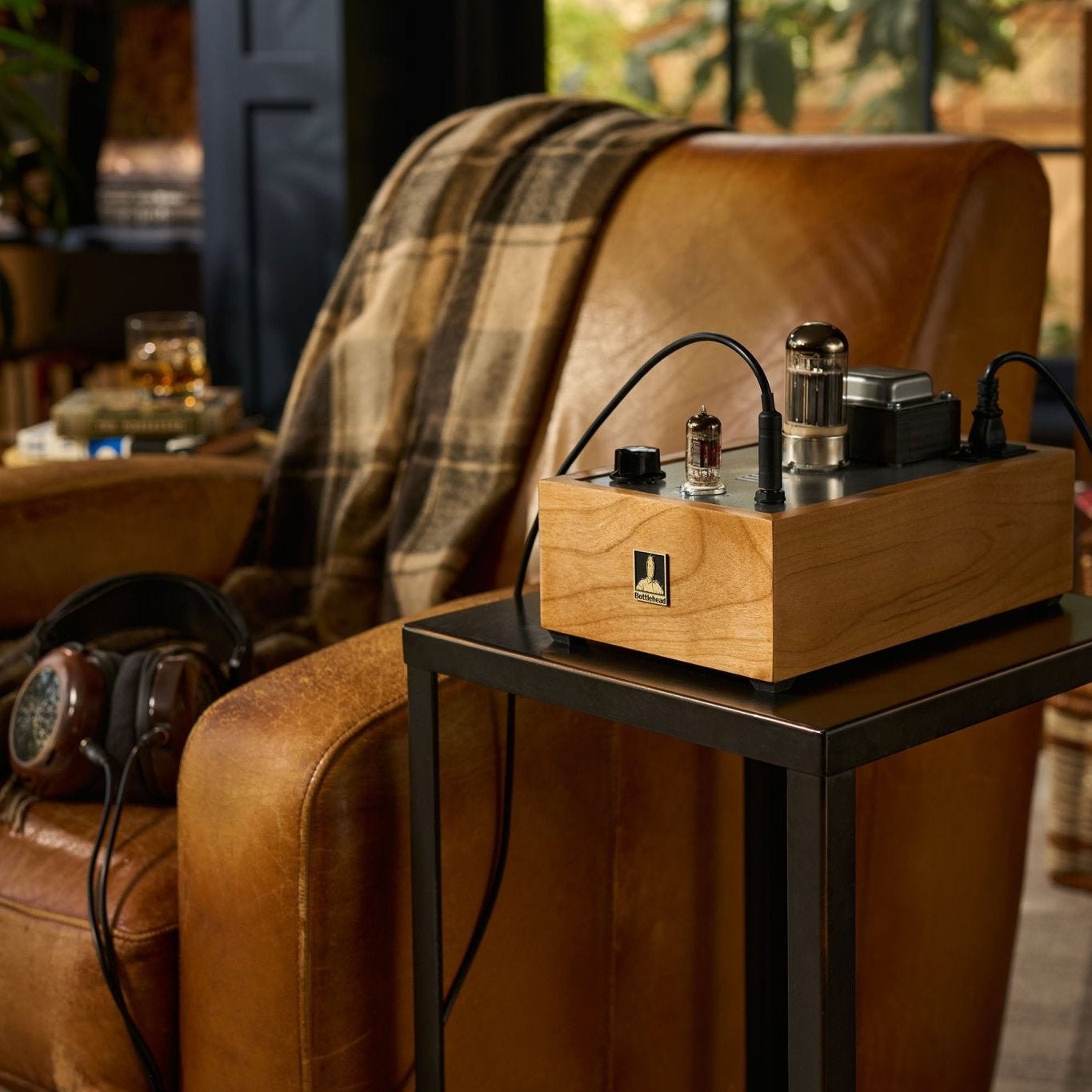
Find the Right Bottlehead Amp for Your Speakers
One of the questions we get most often is whether a particular Bottlehead amplifier will work well with someone’s speakers. It’s a reasonable question, and the answer, unfortunately is usually "it depends." How efficient are your speakers? How far away do you sit? What's your room like? How loudly do you like to listen?
We built a new tool to help answer that question.
It’s a simple calculator that takes some basic information about your speakers and listening habits, estimates how much amplifier power you need, and compares that against the capabilities of our amplifiers.
We think it’ll be useful, especially if you’re new to tube audio or trying to figure out whether a lower-powered amplifier will work in your system. We also know that it's no substitute for experience, so don't be shy about asking in our Forums.
How It Works
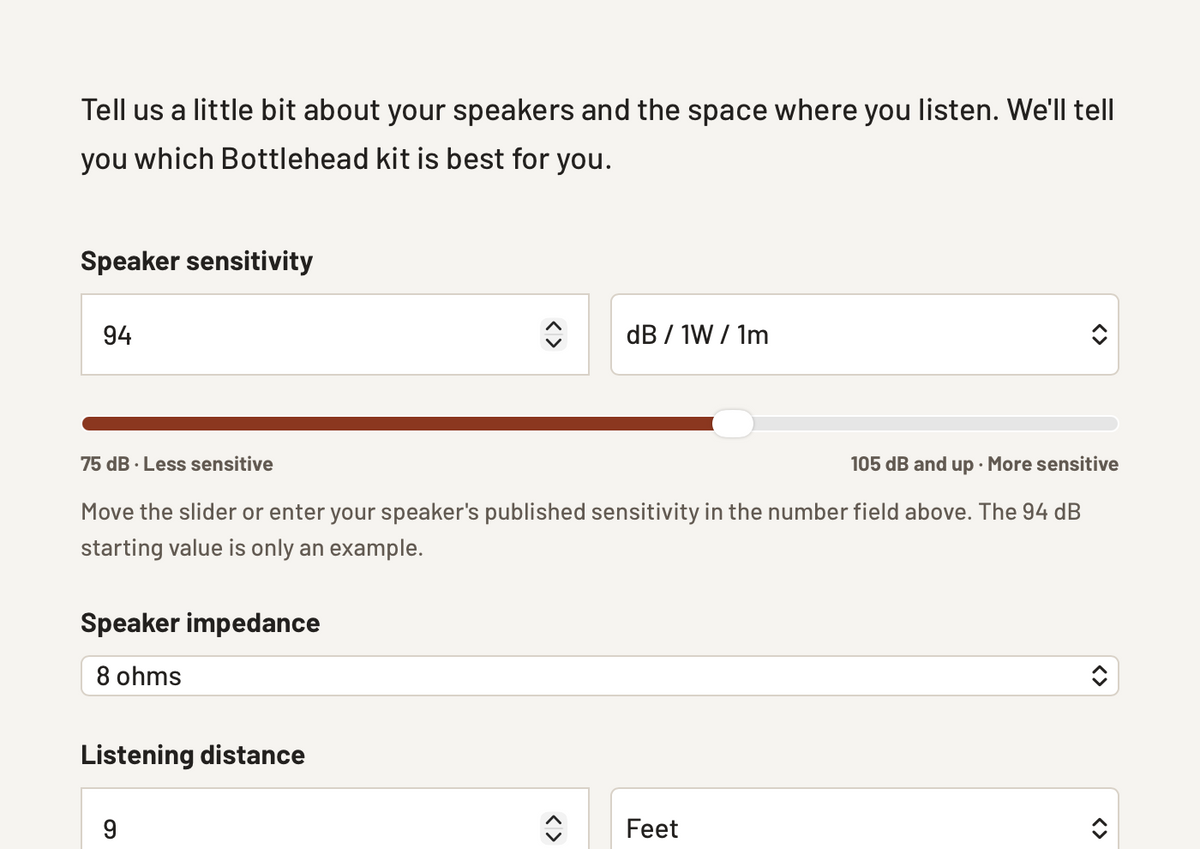
The calculator asks you for a few pieces of information, some of which you'll need to get from your speakers' manufacturer.
Speaker sensitivity tells us how efficiently your speakers convert electrical power into sound. It’s usually expressed in decibels (dB). A speaker rated at 95 dB sensitivity needs roughly one-tenth the power of a speaker rated at 85 dB to produce the same sound pressure level. You should be able to get this spec from your speakers' manufacturer.
You’ll sometimes see sensitivity measured at 1 watt and sometimes at 2.83 volts. Those aren’t necessarily equivalent, depending on the speaker’s impedance. The tool accounts for the difference.
Speaker impedance tells us something about the electrical load your speakers present to the amplifier. It’s measured in ohms, and it’s important because our amplifiers have specific output impedance configurations. A speaker’s published impedance is nominal, meaning the actual impedance varies with frequency. Nearly all Bottlehead amplifiers can be configured for different impedances.
Listening distance matters because sound pressure generally decreases as you move away from a speaker. Room reflections complicate that relationship, so the calculator uses a simplified model. It won’t know exactly how sound behaves in your room.
Listening volume is probably the most subjective input. Some people listen quietly, while others like to turn things up. We use your selection to estimate how much power you’ll need to reach your preferred listening level. Remember that this is the average listening level, not the peak listening level.
Once you’ve entered everything, the tool estimates your power requirements and shows you which Bottlehead amplifiers are likely to work well, which might be marginal, and which might not be a good match.
A Few Things About Amplifier Power
Wattage gets far too much attention in audio. That's our opinion, anyway. Manufacturers have spent decades competing over power ratings to show massive wattage numbers as a marketing ploy. To pump those numbers up, the conditions under which those ratings are measured aren’t always consistent. At Bottlehead, we tend to rate our amplifiers conservatively.
In all actuality, a few watts can produce plenty of volume with efficient speakers. That’s why a 3.5-watt Stereomour II can be a great match for some systems and completely inappropriate for others.
More power also doesn’t automatically mean better sound. There are plenty of other factors that influence how an amplifier performs, and a lot of those differences come down to personal preference. You can also overpower speakers. We try to flag when we think one of our amps may overdrive your speakers. Your speakers' manufacturers should tell you what wattages are safe.
There are practical limits. Some speakers simply need more power than our smaller amplifiers can comfortably provide. Our calculator is intended to help you understand where those limits might be.
What the Calculator Can’t Tell You
There are a lot of variables we can’t account for.
Speaker specifications aren’t always measured consistently. Sensitivity ratings may not reflect real-world performance, and impedance can vary considerably across the frequency range.
Your room matters, too. Speaker placement, room size, furnishings, and acoustics all affect what you hear. This tool makes some general assumptions about these things because asking you to measure your room would defeat the purpose of a simple tool.
It also can’t account for every aspect of amplifier behavior. Two amplifiers with similar power ratings can sound very different. Different circuits, transformers, feedback arrangements, and distortion characteristics all influence the result.
And there’s no accounting for taste. No calculator, no Google search, no AI response - hell, no other person - knows what sounds good to you.
We use a set of thresholds to determine whether an amplifier is an excellent match, a good match, marginal, or not recommended. These are guidelines, not hard rules.
You might have a system that our tool considers marginal and be perfectly happy with it. You might also find that an amplifier it recommends doesn’t suit your preferences.
Right now the tool only works with speaker amplifiers. We're considering an update in the future for our headphone amplifiers as well.
One other thing worth mentioning is speaker power handling. Having an amplifier capable of producing more power than your speaker’s published rating doesn’t automatically mean you’ll damage it. How you use that power matters. The reverse is also true. An underpowered amplifier driven into clipping can cause problems. Use some common sense when it comes to volume.
Give It a Try
We built this tool because we wanted to make it easier to understand which of our amplifiers might work in your system without having to dig through a bunch of specifications or do the math yourself. It’s a starting point. Nothing more.
I’d encourage you to play around with it. Try your speakers with different listening distances and volume levels. See how the recommendations change. If you already own one of our amplifiers, compare what the calculator tells you with your own experience.
I’d particularly like to hear from people who find that the recommendations don’t match what they’re hearing. That kind of feedback will help us improve the calculations and assumptions over time.
I can't emphasize this enough: we’re not suggesting that a simple calculator can replace experience, listening, or human perception. Audio is full of things we can measure, but measurements don’t tell us everything about how a system will sound or whether you’ll enjoy it.
If you have questions about a recommendation, want to talk through a particular speaker pairing, or aren’t sure what to make of the results, chat with us on the website or head over to the Bottlehead Forum.
We’re happy to help. Try it out!
Tell us a little bit about your speakers and the space where you listen. We'll tell you which Bottlehead kit is best for you.
SAVE YOUR AMP MATCHES
Want to keep these recommendations handy? Enter your email below to save your amplifier compatibility results and stay connected with Bottlehead.
Picking the Right Kit for your Skill Level